
ZephIR 1.7 Deep-Cooled SWIR Camera
The ZephIR 1.7 is a high-end scientific InGaAs camera for low-noise SWIR imaging. Its 640 × 512 detector, 15 µm pixels, four-stage thermoelectric cooler and forced-air heat removal provide a maintenance-free cooling architecture capable of maintaining the sensor at -80 °C at 20 °C ambient.
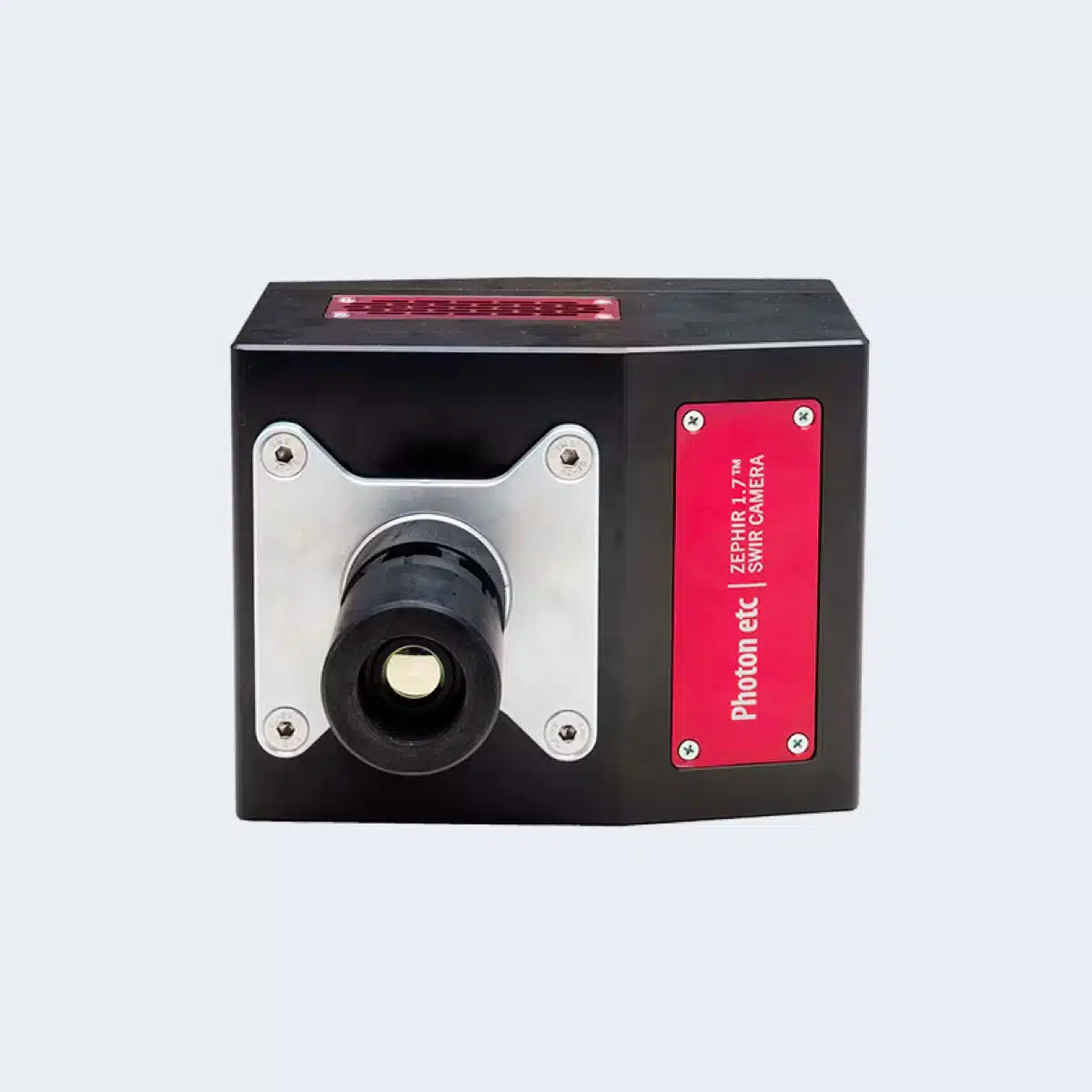
Deep Cooling for Sensitive SWIR Measurements
The ZephIR 1.7 combines an InGaAs focal plane array with state-of-the-art control electronics and a four-stage thermoelectric cooler. The detector can be maintained at -80 °C at a 20 °C ambient temperature, substantially reducing dark current for demanding low-signal and long-integration measurements.
The TEC uses forced-air cooling, avoiding the water circulation or liquid-nitrogen handling required by many traditional deeply cooled scientific cameras.
- Four-stage thermoelectric cooling
- Forced-air heat removal
- Low dark current
- Low readout noise
- High detector operability
- External Trigger IN / OUT
- PHySpec™ control software
- C++ and Python SDK
Why Choose ZephIR 1.7?
ZephIR 1.7 is intended for scientific imaging where sensitivity, detector cooling, low noise and acquisition flexibility matter more than compact machine-vision form factor. The maintenance-free TEC + air system is especially attractive for laboratories that need deep cooling without plumbing or cryogens.
ZephIR 1.7x and ZephIR 1.7s Models
Two detector configurations cover either a broader visible-to-SWIR response or the standard InGaAs SWIR band. Both use a 640 × 512 InGaAs FPA with 15 µm pixels, -80 °C TEC cooling, USB 3.0 and Camera Link interfaces, 12 V DC power and external trigger I/O.
ZephIR 1.7x
500-1700 nm spectral range with peak quantum efficiency above 85%. The 1.7x extends sensitivity into visible and near-infrared wavelengths while retaining full SWIR response through 1700 nm.
- 640 × 512 InGaAs FPA
- 15 µm pixels
- 500-1700 nm spectral range
- Typical operability > 99.9%
- Typical dark current: 125 e-/px/s*
- 110 or 220 fps, depending on readout mode
- ROI frame rate up to 500 or 900 fps
- 13-bit digitization
ZephIR 1.7s
900-1700 nm spectral range with peak quantum efficiency above 80%. The 1.7s is optimized for conventional InGaAs SWIR imaging and provides the highest full-frame and ROI rates in the ZephIR 1.7 family.
- 640 × 512 InGaAs FPA
- 15 µm pixels
- 900-1700 nm spectral range
- Typical operability > 99.5%
- Typical dark current: 150 e-/px/s*
- Up to 250 fps full frame
- ROI frame rate up to 4300 fps
- 14-bit digitization
*Typical dark-current values are stated by the manufacturer using a cold target.
Technical Specifications
| Specification | ZephIR 1.7x | ZephIR 1.7s |
|---|---|---|
| Sensor | InGaAs FPA | InGaAs FPA |
| Sensor format | 640 × 512 | 640 × 512 |
| Pixel size | 15 µm | 15 µm |
| Spectral range | 500-1700 nm | 900-1700 nm |
| Peak quantum efficiency | > 85% | > 80% |
| Typical operability | > 99.9% | > 99.5% |
| Cooling temperature at 20 °C ambient | -80 °C | -80 °C |
| Cooling method | TEC + forced air | TEC + forced air |
| Typical dark current* | 125 e-/px/s | 150 e-/px/s |
| Typical gain setting | 2.67 / 47.5 e-/ADU | 2.2 / 7.4 / 89 e-/ADU |
| Typical readout noise | 22 / 135 e- | 28 / 75 / 315 e- |
| Typical full well capacity | 8.5 / 250 ke- | 27 / 110 / 1400 ke- |
| Readout modes | CDS ITR / STD ITR | CDS ITR, CDS IWR, IMRO IWR |
| Frame rate | 110 / 220 fps | 250 fps |
| ROI frame rate | Up to 500 / 900 fps | Up to 4300 fps |
| Integration time | From 1 µs to full well capacity | From 1 µs to full well capacity |
| Digitization | 13 bits | 14 bits |
| Image format | 16-bit HDF5, FITS and TIFF | 16-bit HDF5, FITS and TIFF |
| Software / SDK | PHySpec™; C++ and Python SDK | PHySpec™; C++ and Python SDK |
| Computer interface | USB 3.0 and Camera Link™ | USB 3.0 and Camera Link™ |
| External control | Trigger IN / OUT | Trigger IN / OUT |
| Ambient temperature range | 10 °C to 35 °C | 10 °C to 35 °C |
| Power supply | 12 V DC | 12 V DC |
| Dimensions | 169 × 130 × 97 mm | 169 × 130 × 97 mm |
| Weight | 2.9 kg | 2.9 kg |
*Using cold target. Specifications are based on the supplied Photon etc. ZephIR 1.7 specification sheet.
Typical Applications
Low-Light Scientific Imaging
Deep -80 °C cooling and low dark current make the ZephIR 1.7 well suited to low-flux measurements, long integration times and experiments where detector noise must be minimized.
Spectroscopy & Photonics Research
High quantum efficiency, external triggering, scientific image formats and C++/Python SDK support make the camera a strong detector platform for spectroscopy, photonics and optical research systems.
SWIR Laboratory Imaging
The 640 × 512 InGaAs format supports material studies, laser visualization, photoluminescence-related imaging and other laboratory applications requiring high SWIR sensitivity.
Software and System Integration
ZephIR 1.7 cameras are supported by PHySpec™ control and analysis software and SDK support for C++ and Python. USB 3.0 provides convenient direct-to-PC connectivity, while Camera Link supports integration with compatible scientific and industrial acquisition hardware.
- PHySpec™ camera control and analysis software
- C++ and Python SDK
- 16-bit HDF5, FITS and TIFF image formats
- External Trigger IN / OUT
- USB 3.0 and Camera Link connectivity
Pembroke Application Support
Pembroke Instruments can help evaluate whether the ZephIR 1.7x, ZephIR 1.7s or another SWIR camera is best for your wavelength range, exposure time, frame rate, field of view, optics, illumination, triggering and software requirements.
Need Help Selecting the Right Deep-Cooled SWIR Camera?
Tell Pembroke Instruments your wavelength range, exposure time, frame rate, field of view, working distance, interface and software environment. We can help determine whether the ZephIR 1.7x, ZephIR 1.7s or another SWIR camera is the best fit.