
SWIR Imaging for Semiconductor Inspection and Electronics Analysis
Short-wave infrared (SWIR) imaging helps engineers inspect silicon wafers, packaged devices, MEMS structures, interconnects, and electronics assemblies when visible cameras cannot reveal enough information. Because silicon becomes increasingly transparent at SWIR wavelengths, a SWIR camera or SWIR microscope can support non-destructive inspection, failure analysis, process development, and advanced semiconductor research.
Pembroke Instruments helps research labs, failure analysis teams, and process engineers select SWIR cameras, SWIR microscope configurations, SWIR hyperspectral imaging systems, and related optics for semiconductor inspection.

SWIR microscopy can reveal semiconductor structures and features hidden to visible imaging.
Why SWIR Imaging Works for Semiconductor Inspection
Visible cameras are excellent for surface inspection, but they cannot see through silicon. SWIR imaging gives semiconductor engineers another inspection modality: one that can reveal internal structures, buried features, die attach issues, wafer defects, and packaging-related problems without cutting the sample apart.
Through-Silicon Imaging
Silicon is opaque in the visible spectrum but becomes more transmissive in the SWIR range. This allows SWIR cameras to inspect features beneath the surface of silicon wafers and devices.
Non-Destructive Failure Analysis
SWIR microscopy can help locate cracks, voids, alignment errors, and internal structures before destructive cross-sectioning or more expensive analysis methods are used.
Packaging and Interconnect Inspection
For advanced packaging, SWIR imaging can support inspection of bonded wafers, device stacks, MEMS structures, and packaged components where internal alignment matters.
Complementary to Thermal Imaging
SWIR reveals structural and optical information. Thermal microscopes reveal heat generation, current leakage, and powered-device behavior. Together, they help diagnose different classes of electronics problems.
Helpful Imaging Examples for Semiconductor and Electronics Workflows
Image-based sections help visitors immediately understand the difference between SWIR inspection and thermal microscopy. Use these blocks to keep the page visual, practical, and application-focused.
SWIR Microscope for Wafer and Die Inspection
Use SWIR microscopy when the task is to inspect silicon wafers, die, bonded structures, device layers, or features hidden below the surface.
View SWIR microscope options →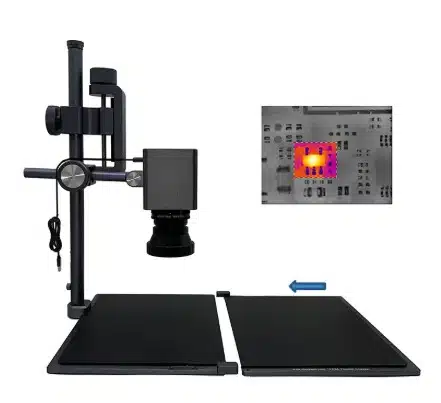
Thermal Microscope for Powered Electronics
Use thermal microscopy when the problem is electrical or thermal: shorts, leakage paths, localized hotspots, latch-up events, or thermal behavior under power.
View thermal microscope products →Semiconductor Defects and Features Detected with SWIR Imaging
SWIR inspection is most valuable when internal structure, silicon transparency, or wavelength-dependent contrast provides information that a standard visible camera cannot capture.
Wafer Cracks and Edge Damage
Identify cracks, chips, and subsurface defects that may not be obvious in visible-light inspection.
Voids and Bonding Defects
Support inspection of bonded wafers, die attach regions, and packaging interfaces where internal voids may affect reliability.
Alignment and Registration
View alignment features through silicon to help evaluate wafer bonding, stacked devices, MEMS assemblies, and package structures.
Interconnects and Wire Bonds
Inspect internal features in packaged devices and electronics assemblies where visible access is limited.
MEMS and Microstructures
Analyze microstructures and cavities where SWIR transparency can reveal features buried below the surface.
Material and Process Variation
Use SWIR contrast to investigate non-uniformities associated with process development, inspection, and research.
SWIR vs. Thermal Microscopy for Semiconductor and Electronics Analysis
SWIR and thermal microscopy answer different questions. SWIR is typically selected for through-silicon and structural inspection. Thermal microscopy is selected when the goal is to see heat patterns, current leakage, localized hotspots, and powered-device behavior.
| Inspection Question | Best Technology | Why It Helps | Relevant Page |
|---|---|---|---|
| Can I see through silicon? | SWIR camera / SWIR microscope | Silicon becomes more transparent in the SWIR range, enabling internal inspection. | SWIR cameras → |
| Where is the device heating under power? | Thermal microscope | Thermal imaging reveals heat generation, hotspots, leakage paths, and powered-device behavior. | Thermal microscopes → |
| Do materials or layers have different spectral signatures? | SWIR hyperspectral imaging | Hyperspectral systems add spectral information at every pixel for advanced material analysis. | SWIR hyperspectral systems → |
| Do I need inline inspection or a lab microscope? | Application-dependent | Field of view, resolution, speed, optics, and workflow determine the right system configuration. | Discuss setup → |
SWIR Imaging System Configurations for Semiconductor Work
SWIR Microscope Systems
Best for laboratory inspection, failure analysis, wafer review, die inspection, and high-magnification semiconductor imaging.
SWIR microscope options →SWIR Area-Scan Cameras
Useful for flexible lab imaging, machine vision setups, microscope integration, and inspection stations requiring full-frame capture.
Compare SWIR cameras →SWIR Line-Scan Inspection
Appropriate for moving samples, conveyor inspection, wafer scanning, and high-throughput industrial inspection workflows.
View spectral imaging systems →Thermal Microscope Systems
Used when the key question is heat generation, electrical failure, current leakage, short circuits, or active device diagnostics.
View thermal microscope products →How to Select the Right SWIR Semiconductor Inspection System
The best configuration depends on the sample, inspection target, wavelength range, magnification, illumination, working distance, sensor format, pixel size, frame rate, and software workflow. Pembroke Instruments can help narrow the options before you invest time in a full evaluation.
Key Questions to Define
- Are you inspecting bare wafers, packaged devices, MEMS, PCB assemblies, or bonded structures?
- Do you need through-silicon imaging, thermal hotspot detection, or both?
- What field of view and spatial resolution are required?
- Is this a lab microscope setup, OEM integration, or inline inspection station?
Common System Components
- SWIR camera or thermal camera matched to the application
- Microscope optics or SWIR-compatible lenses
- Appropriate SWIR or thermal illumination strategy
- Acquisition software, image processing, and integration support
Talk to Pembroke Instruments About Semiconductor Inspection
Pembroke Instruments works directly with engineers and researchers to select SWIR cameras, thermal microscopes, hyperspectral systems, optics, and software workflows for semiconductor inspection and electronics analysis.