
While visible light cameras rely on silicon, Short-Wave Infrared (SWIR) works in a much different way. To capture photons between 900 nm and 2500 nm, we have to manipulate the very atomic structure of the sensor materials. High-performance SWIR imaging is the result of a careful balance of physics.
Bandgap Engineering in InGaAs for Extended SWIR Detection (1.7–2.5 µm)
Standard SWIR sensors use Indium Gallium Arsenide (InGaAs) lattice-matched to an Indium Phosphide (InP) substrate. “Standard” InGaAs has a bandgap of approximately 0.73 eV, which corresponds to a cutoff wavelength of 1.7 µm.
To see further into the infrared (up to 2.5 µm), we use bandgap engineering. By increasing the indium mole fraction, we decrease the energy bandgap. By increasing the amount of indium, you physically stretch the sensor’s atomic lattice with larger atoms. This loosens the internal electrical grip on electrons, lowering the energy barrier they must cross to create a signal.
The result is a sensor that can see deeper into the infrared spectrum, catching lower-energy light that standard sensors would miss — though this stretched-out structure is more prone to heat-induced noise and manufacturing defects. Manufacturers grow “metamorphic” buffer layers to grade this mechanical strain.
Comparing InGaAs and HgCdTe for SWIR: Noise, Cooling, and Cost Trade-offs
For decades, Mercury Cadmium Telluride (HgCdTe or MCT) was the preferred choice for high-end infrared imaging. Today, InGaAs is the dominant force in the SWIR band, though MCT remains relevant for specific high-performance niches.
| Feature | InGaAs (Standard) | HgCdTe (MCT) |
|---|---|---|
| Spectral Range | Fixed (typically 0.9–1.7 µm) | Tunable (SWIR to LWIR) |
| Quantum Efficiency | High (>80%) | Very High (>90%) |
| Operating Temp | Room Temp to -20°C | Often requires Cryogenic (77K) |
| Dark Current | Low | High (requires heavy cooling) |
| Cost | Moderate | Very High |
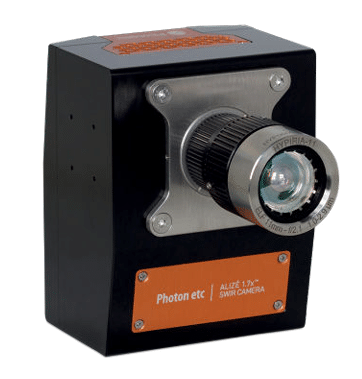 The result: InGaAs is robust, requires less cooling, and integrates easily into industrial environments. MCT offers unparalleled sensitivity and tunable bandwidth, but requires complex Stirling coolers and is consequently the more expensive choice.
Spectral Response Curves: QE, Cutoff Wavelengths, and Practical Impacts
A sensor’s spectral response curve tells you how efficiently it converts incoming photons into electrons. This is measured as Quantum Efficiency (QE).
- The Cut-on: In standard SWIR sensors, the InP substrate blocks light below 900 nm. Visible-InGaAs sensors remove or thin this substrate to extend sensitivity down into the visible range (400 nm).
- The Cutoff: This is the point where photon energy is no longer sufficient to kick an electron across the bandgap. A sharp cutoff is desirable for precise filtering.
- Practical Impact: If you are imaging through glass, a standard 1.7 µm sensor is ideal. If you are performing laser profiling at 2.1 µm or plastic sorting (identifying HDPE vs. LDPE), you must move to an extended InGaAs sensor, even if it means accepting higher noise.
Room-Temperature vs. Cooled SWIR Cameras: When Dark Current is a Limiting Force
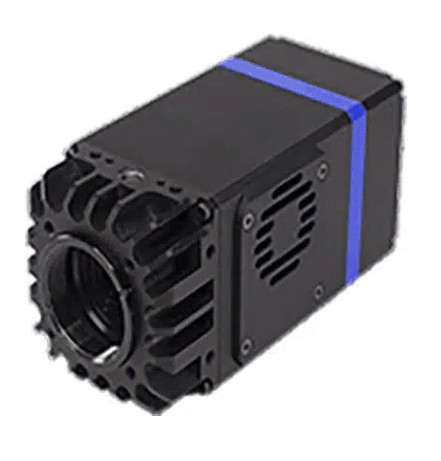 Even at room temperature, the heat is sufficient to cause random thermal excitation of electrons and cause the sensor to generate a signal even when no light is hitting it. This is known as dark current, and it must be corrected for the best results. For every 7°C to 8°C you cool the sensor, you reduce the dark current by half.
When is room temperature sufficient?
- High-light applications such as outdoor surveillance.
- High-speed imaging, since short integration times means less time for dark current to accumulate.
- Handheld/Portable devices where power and weight are critical.
When do you need Thermoelectric Cooling (TEC)?
- Low-light scenarios: When the signal you’re looking for is buried in the “floor” of the thermal noise.
- Precision Metrology: When you need a highly stable baseline for quantitative measurements.
- Extended SWIR: Because the bandgap is narrower in 2.5 µm sensors, electrons jump it much more easily at room temperature.